
Dream for a Requiem
A singer gets iced; choose your own (concert) adventure; Mozart dies another day

Name That Tune
This week’s Name That Tune is a Joey Special. Here’s your hint: this piece is part of a set of pieces that were inspired by the works of a painter of the same nationality as this composer.
As always, your goal is to provide as much accurate analysis as possible. First try to get the nationality, year, and genre, then make educated guesses about the composer and — if possible— the piece. If you know the piece immediately, send us an email at toneprose@substack.com instead of commenting so the rest of us can have fun guessing.
Last Week’s Results
Tone Prose 169
Howard Hanson, Symphony No. 6
Nobody landed on the correct American this week. Guesses ranged from MacDowell, Griffes, and Barber (Joey) to Walton, Bloch, Herrmann, and Adams (Listener Kevin) to a second vote for Barber plus Piston (LIstener Eric) and even John Williams (Listener Ellen).
Better luck next Thanksgiving!
Think you can stump your fellow Listeners? Go ahead and try!
Head to our Google Form to submit a YouTube link OR upload your own 30-second clip of an unidentified piece of classical music for us to try to identify.
Che gelido la manina
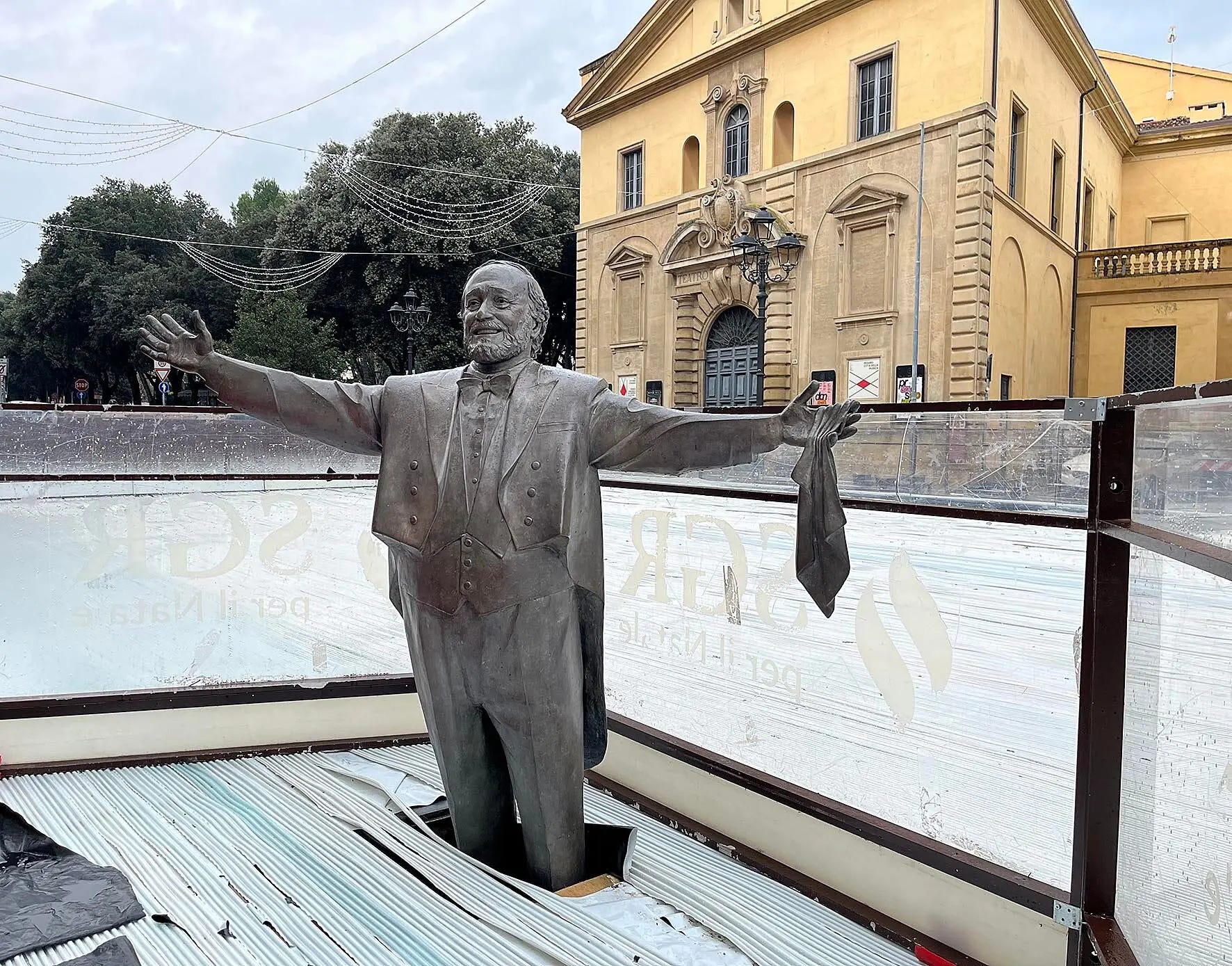
In an indication that literally every person on the planet needs to find better uses for their time and attention, this story was reported by several reputable news outlets this past week, including The Guardian:
An Italian mayor has apologised to the family of Luciano Pavarotti after a Christmas ice rink entrapped a statue of the legendary opera singer – and skaters were invited to “give [him] a high five”.
The lifesize bronze, featuring Pavarotti wearing a tailcoat with his arms outstretched and holding a handkerchief in one hand, was unveiled to much fanfare last year in a square in the centre of Pesaro, a coastal city in the Marche region.
The statue was intended as a tribute to the late tenor, who had a home and honorary citizenship in Pesaro, also the birthplace of the Italian composer Gioachino Rossini.
But instead, surrounding Pavarotti with “a very ugly” ice rink had “ridiculed” his memory, Nicoletta Mantovani, the tenor’s widow, said after images of the statue “trapped” up to its knees were circulated online.
Mantovani told the local newspaper Il Resto del Carlino that she was “disappointed, angry and upset”.
You Be the Maestro
Here’s a little discussion question for the comments section:
I’ve engaged a soloist to perform with one of my orchestras next year, and the piece is Shostakovich’s Piano Concerto No. 2 in F major.
When I program a concert, there are many, many factors that go into the decision-making process: overall length of the program; repetition avoidance with recent repertoire; logistical concerns; time of year; the difficulty of the works and the capabilities of the orchestra; placement in the season; thematic concept; etc.
But I’m not imposing any such rigors upon you. What would you program with this piece to make a program of 65-80 min of music for an orchestra concert? Note: I want to see your reasoning.
Guest Concert Report
Chicago Symphony Orchestra: Honeck Conducts Mozart Requiem
November 20, 2025, Orchestra Hall
Submitted by Listener Jeremy
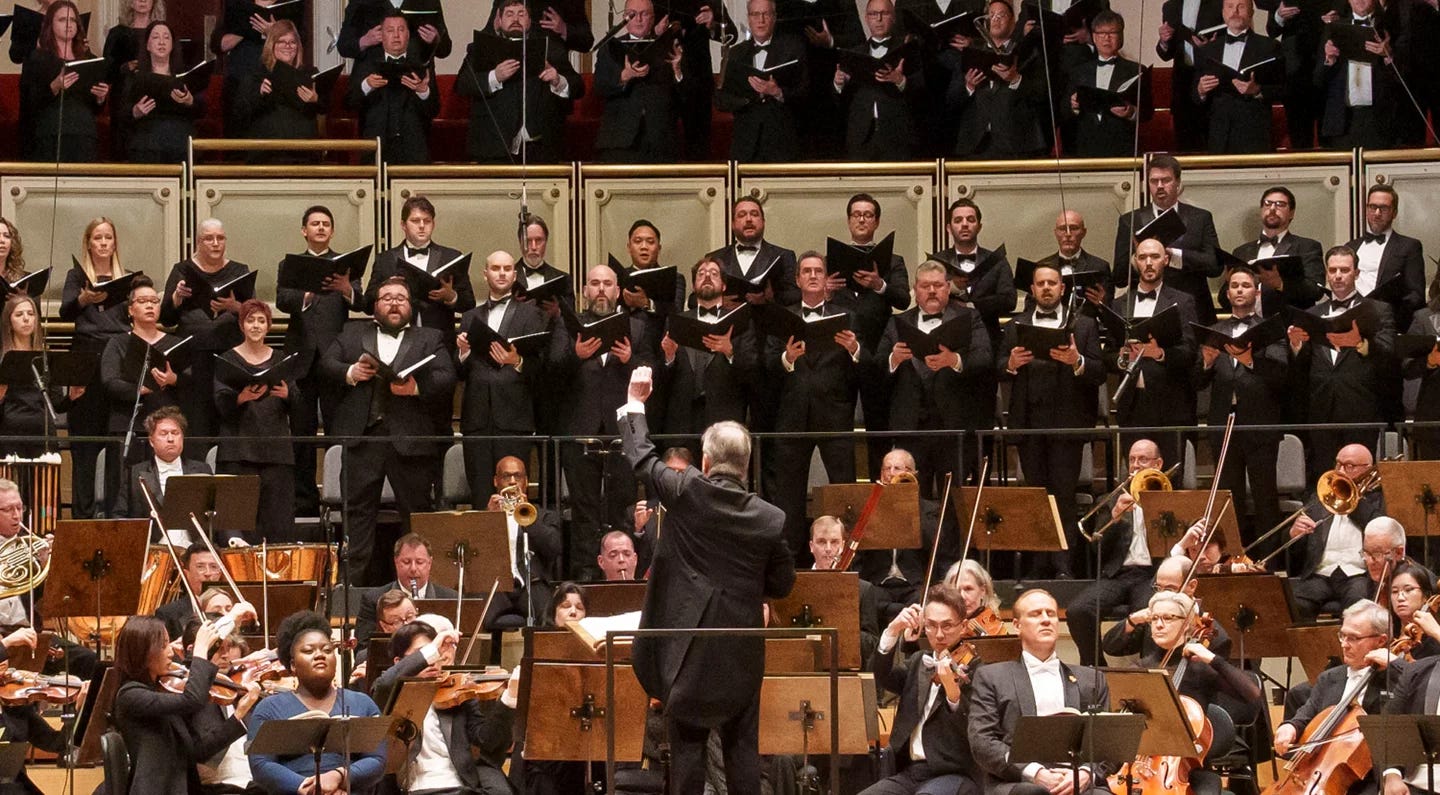
When I informed Maestro Will that I would be attending the Chicago Symphony Orchestra’s performance of Manfred Honeck’s interpretation of Mozart’s Requiem, he pointed me towards his Dave Hurwitz’s recent review of the recording. If you don’t want to watch Hurwitz’s 10 minute rant, I can summarize it for you: he hates it.
Maybe it wasn’t the best idea to go into the concert primed in this way, but it turns out I hated it too, but for almost entirely different reasons. The program removes the parts of the Requiem completed by Süssmayr, interpolates other music by Mozart (other sacred works, plus the Masonic Funeral Music) as well as some Gregorian chant in order to depict Mozart’s death in the context of a mass.
Hurwitz thinks this is in poor taste. He finds the whole concept of thinking about and focusing on Mozart’s death in this way is “morbid and creepy,” and questions who would care about a dramatic representation of Mozart’s death. I think he needs look no further than the success of Amadeus (and its inspiration, Pushkin’s Mozart and Salieri) to find that Mozart’s death has fascinated people for centuries. Death is fascinating. Mozart is a character. Mozart dying young while writing a Requiem is legendary. Presenting Mozart’s Requiem as a sort of theatrical memento mori is good dramatic concept
For me, the problems with this interpretation of the Requiem are two-fold: The first is that it didn’t go far enough with the theatricality. There was no staging, no lighting, no actual dramatic presentation. There were some mildly theatrical elements (it begins and ends with 3 ominous chimes, the singers for the chant were offstage, the vocal quartet was in a corner of the stage rather than up front, the trombone on “Tuba Mirum” was on above the orchestra on the wings), but for the most part, it was played and performed straight.
So what we were left with was the music, which was entirely disjointed as it bounced from work to work, interrupting the Requiem with unrelated pieces that didn’t flow together. Instead of a dramatic attacca between pieces and movements, there were over-long pauses. Attempts at adding drama to the music itself fell flat, such as over-enunciation in the “Et lux perpetua” section or a bizarre decision to have the singers roll their Rs in “Rex tremendae”. Somehow, the “Confutatis” came across as plodding instead of fiery. There was no actual drama to be found here.
On the album (and the original performance in Pittsburgh), there are dramatic readings of various texts, but these were entirely left out of this touring version of the concept. Admittedly, some of the readings sound a bit unrelated (poems by holocaust survivor Nelly Sachs), but this production needed something more than what was presented. The entire vibe was one of sterile sobriety rather than theater. This was billed as a “dramatic and immersive performance” and it was neither. And none of this was helped by the CSO’s abominable practice of keeping the house lights on whenever there are vocals on the program (in order to allow and encourage the audience to read translations and rustle programs instead of paying attention to the music).
The other main problem with this is that Mozart’s Requiem doesn’t need any changing. It doesn’t need any help to be theatrical. It’s wildly dramatic already. From the ominous introduction to the fires of the “Dies irae” to the heartbreak of the lacrimosa, it fulfills every dramatic brief and tells a phenomenal story. The Requiem doesn’t need saving from the fact that it was incomplete at his death (Süssmayr’s completion is extremely successful, period appropriate, and makes the obviously correct choice to reuse as much material as possible). The Requiem is a fantastic work on its own (Hurwitz disagrees, and is wrong). Manfred Honeck (whom I otherwise quite like), took away all the Requiem’s inherent drama and didn’t replace it with anything nearly enough to justify chopping it up.
But, the audience gave it an immediate standing ovation, so what do I know?
Tone Praise
Brahms, Hungarian Dance No. 5
In honor of the accordion being named Instrument of the Year by the German Ministry of Culture.
Tone Prose is a co-production of William White, Joseph Vaz, and the Listeners (i.e. you.)
NTT: I would have said Russian until the ending which through me for a bit of a loop. Rachmaninoff was the first composer who came to mind (all the chromaticism.)
The perkiness of the ending had me thinking this could maybe be Poulenc, but then it stayed too normal for too long.
I'll have both of them in my bucket, and maybe I'll add Glazunov.
The clue is of precious little help... the only “painting” suites I can think of are Mussorgsky's “Pictures” and Gunther Schuller's godawful Paul Klee pieces.
A (60-ish-minute) program including Shostakovich's second piano concerto:
Chabrier - Joyeuse Marche
Gipps - Death on the Pale Horse
Adès - The Exterminating Angel Symphony
Busoni - Berceuse élégiaque
Shostakovich - Piano Concerto No. 2
The march style of the concerto's outer movements got me thinking about other orchestral marches. Assuming ending with the concerto, the Chabrier I like as the concert's other bookend. For a march of a different character, I landed on the second movement of the Adès, and with the death (whether literal or metaphorical) lurking in that piece(/opera) as a whole, the Gipps and Busoni seemed like possible linking works.