
195: Californication
SF and LA get new chiefs

Name That Tune
This week’s Name That Tune is a Joey Special. Same hint as a few weeks ago: this is a recording of the composer playing their own piece.
As always, your goal is to provide as much accurate analysis as possible. First try to get the nationality, year, and genre, then make educated guesses about the composer and — if possible— the piece. If you know the piece immediately, send us an email at toneprose@substack.com instead of commenting so the rest of us can have fun guessing.
Last Week’s Results
Tone Prose 194
Grainger, In a Nutshell: 4. Gum-suckers’ March
Everyone guessed right! (Well, everyone guessed the composer right — nobody was bold enough to go for the piece.) Listener Laurie was first in, followed by a backup from Listener Ebenedict, and Listener Jeremy pulled up the rear.
Bravi tutti, or, as Grainger — who was so devoted to using the vernacular that he called violas “middle fiddles” — would have said, Well Done Everyone!
Think you can stump your fellow Listeners? Go ahead and try!
Head to our Google Form to submit a YouTube link OR upload your own 30-second clip of an unidentified piece of classical music for us to try to identify.
Musical Chairs
Two big music director appointments were announced in California this past week: Elim Chan as the new music director of the San Francisco Symphony and Daniel Harding as the new music director of the Los Angeles Philharmonic.

Elim Chan was born and raised in Hong Kong and moved to the U.S. to attend Smith College, where she sang in student choruses and got some opportunities to conduct. She then matriculated to the University of Michigan, where she earned both masters and doctoral degrees in orchestral conducting.
I gotta say, it’s wild to me that someone roughly my age with a nearly identical educational profile to me is conducting one of America’s “Big Seven” orchestras (more about that below.) In fairness, I never got a doctorate, but in some ways, that makes Chan’s appointment more surprising, not less. In the world of orchestral conducting, a doctorate is often seen as a hindrance to a career in professional orchestras, the idea being that you’re supposed to go from your masters directly to an assistantship, which serves as your finishing school. Doctorate-holding conductors are supposed to be relegated to academia.
Well, obviously Elim Chan didn’t get the memo, and everything changed for her when she won the Donatella Flick conducting competition in 2014, the first woman to do so. From there, she went to the London Symphony as assistant, then to LA as a Dudamel fellow, then to the Norrland Opera in Sweden as music director, then to the Antwerp Symphony as music director.
That’s already a big career, but San Francisco is an appointment of an order of magnitude higher than anything she’s had so far. There was a fair amount of kerfuffle in the online commentariat when it was widely reported that Chan has become the first woman to lead a “major American orchestra,” because we’ve already had Joanne Falletta in Buffalo, Marin Alsop in Baltimore, Natalie Stutzmann in Atlanta, and Xian Zhang in Seattle.
Those are great orchestras, but let’s be honest: they ain’t San Francisco. There’s a traditional “Big Five” group of American orchestras consisting of the New York, Philadelphia, Boston, Cleveland, and Chicago; this is considered long-defunct as a category, so many now talk about the Big Seven, which adds San Francisco and LA.
I think I mostly agree with Dave Hurwitz’s take on the Chan appointment: it’s a smart bet that largely clears the air of the stink it acquired when Esa-Pekka Salonen left in a huff of European entitlement. There’s a big opportunity here, especially if Chan can manage to increase the number of weeks she spends in residency with the orchestra each season.
The last thing to say about this is that someone at SF Classical Voice did a big oopsie on the morning of the announcement by scheduling their Facebook post several hours prior to the lifting of the embargo on the announcement. So I had several people sending me the post way before you could find the information anywhere else, much less on the SFS website.
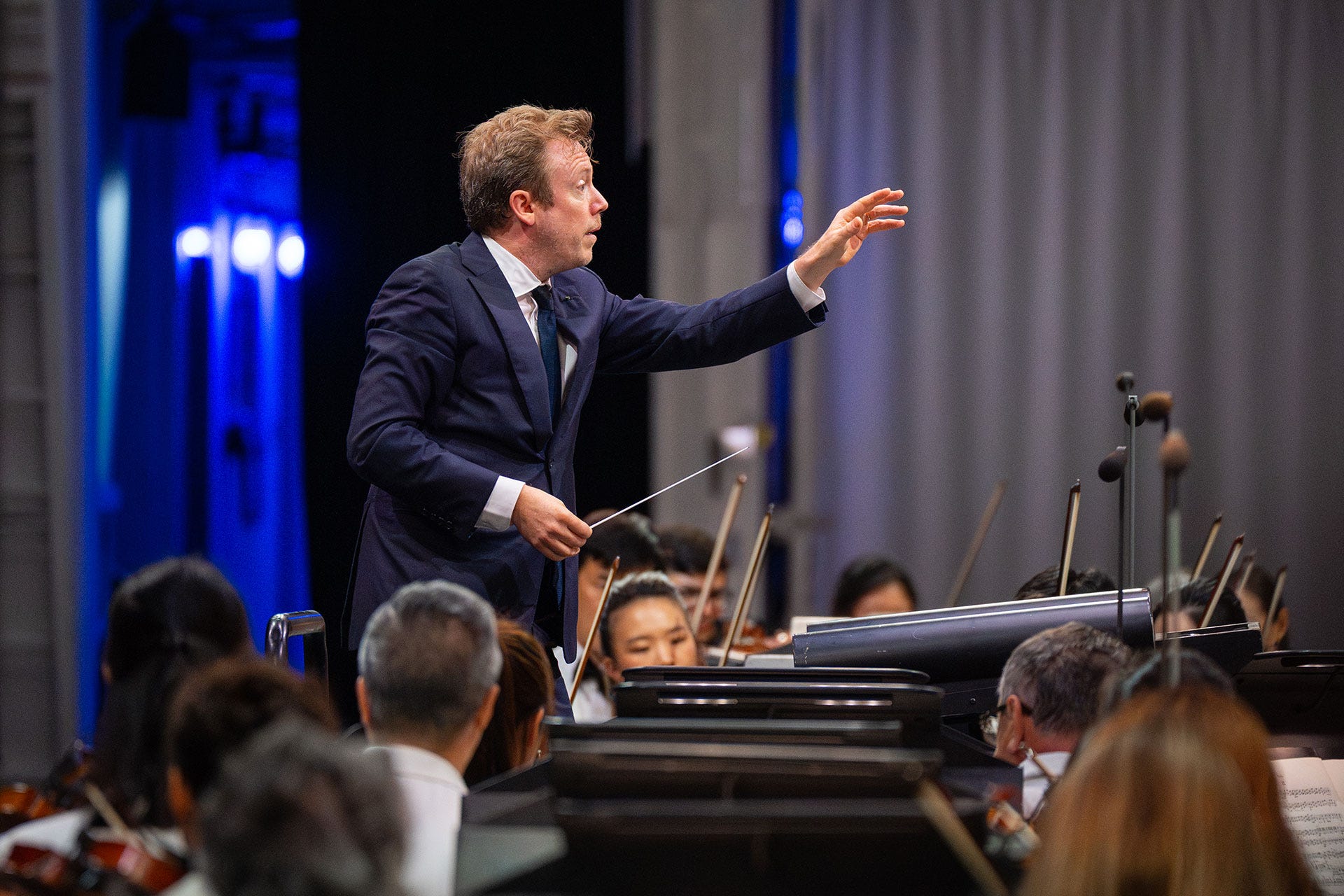
The announcement of Daniel Harding’s appointment was paired with another: the LA Phil is also bringing on Anna Handler as Conductor in Residence, a role that the orchestra has created for her. Both of these announcements follow directly on the heels of two other posts for two of the orchestra’s former music directors: Esa-Pekka Salonen has been appointed “Creative Director” and Gustavo Dudamel will stay on in some sort of “conductor laureate” position, though I don’t think it’s been named officially.
That’s a lot of cooks in the kitchen, especially when two of those cooks are the former chefs de cuisine, one of whom is the most charismatic conductor in the biz and the other of whom is a highfalutin artiste with a petulant streak. (I’ll let you decipher who is whom.)
But this structure may be a good fit for Harding, who has dated a lot of American orchestras but always maintained his bachelor status. He’s also got to leave time in his schedule for his day job as an Air France pilot.
So taking stock of The Big Seven, we’ve now got Elim Chan in SF, the Harding harem situation in LA, Mäkelä in Chicago, Dudamel in NY, Yannick in Philly, and vacancies in Boston and Cleveland. That’s a pretty fresh line-up, though it means that in terms of tenure, this is now the grand old man of American orchestral music.
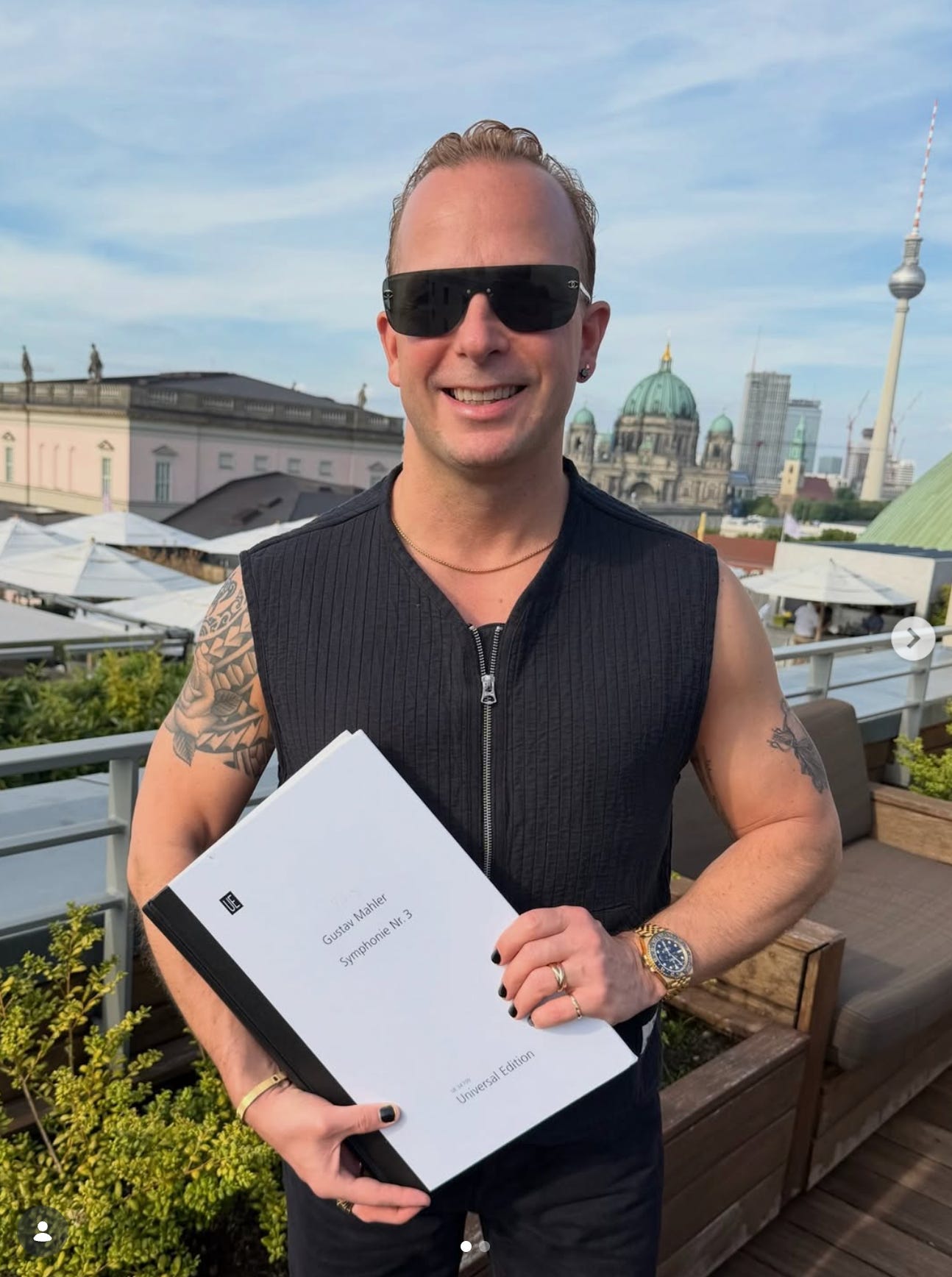
Heaven help us.
Tone Praise
Pierre Mercure, Kaléidoscope
Folks, this is why you go to concerts: you just might hear something new that you really enjoy!
Such was the case when I attended a concert this past weekend and was introduced to the work of the French Canadian composer Pierre Mercure via this piece, which is a really enjoyable listen. My one criticism is that the ending does not carry the weight of what preceded it; he should have taken another crack at it.
Tone Prose is a co-production of William White, Joseph Vaz, and the Listeners (i.e. you.)
On Grainger: If by "the vernacular" you mean "pure Germanic English words unsullied by the language of those darkies down by the Mediterranean," then yes. Louden to the fore!
What an interesting NTT!
At least this time, the music plausibly sounds like it was recorded in an era when some old composer would still have been alive. I'm going to say mid-30s from the distortion of the piano's sonority and the surface noise.
As for the musical style, there's quite a bit of counterpoint here, but then some underlying harmonies that get just a dash of bluesy spice.
Pianist-composers alive and recording during that era, hmmm... Aaron Copland? Henry Cowell?
I don't necessarily know why I'm leaning American. Just a hunch, but maybe I should add someone from afar to that list, so perhaps... Mompou?