
184: Pile-On
Timmy says the quiet part out loud and Andris Nelson gets the boot from Boston

Name That Tune
This week’s Name That Tune is a Joey Special. No hint this week!
As always, your goal is to provide as much accurate analysis as possible. First try to get the nationality, year, and genre, then make educated guesses about the composer and — if possible— the piece. If you know the piece immediately, send us an email at toneprose@substack.com instead of commenting so the rest of us can have fun guessing.
Last Week’s Results
Tone Prose 183
Varèse, Dance for Burgess
I gotta say, this was pretty satisfying. The music fairly screamed “Varèse” at me from the opening second of the clip, and I went with it, and I nailed it. I name-checked Messiah and Babbitt just for funsies, but my heart was always with Edgard.
Listener Eric was right there with me, but his backups were Stravinsky and Hovhaness. Listener Kash found himself a little more confused, but went with Revueltas, also a good guess.
Think you can stump your fellow Listeners? Go ahead and try!
Head to our Google Form to submit a YouTube link OR upload your own 30-second clip of an unidentified piece of classical music for us to try to identify.
Lunacy
I pray that none of you are so chronically online that you got wrapped up in this week’s internet “drama” about Timothée Chalamet being very mean to opera and ballet people.
I really didn’t want to do this as a topic this week because I like to consider Tone Prose an institution that can rise above such inconsequential banality, but the “scandal” broke containment and infected the broader culture (well, the broader online culture) making its way into The Onion and SNL, so I suppose it has to be addressed briefly.
The gist is this: in an Oscar-campaign interview with Matthew McConaughey, Chalamet said something to the effect of, “I hope that cinema remains a vital part of the culture, and doesn’t find itself a niche product like opera and ballet, which nobody really cares about.”
As soon as that clip hit the internet, every singer, dancer, and instrumentalist joined the pile-on, and a bunch of social media managers at big arts institutions went all in on the opportunism:

And this, in spite of the fact that this is the exact gripe that these people are constantly moaning about themselves.
My take is this:
Opera and Ballet and the other “high arts,” while once more popular than they are today, were never mass entertainment. To the extent that they were, it’s because they were incorporated into mass entertainment, i.e. the cinema. (See: The Red Shoes, Citizen Kane, Carnegie Hall, etc.)
Chalamet had every right to say what he said, though he phrased it rather inelegantly (which should come as no surprise, since, if you’ve been paying attention at all, you will know that he’s not very smart, or, frankly, very talented in his chosen field.)
The people who immediately started jumping up and down about this proved that, if anything, the problem is worse than he said it was. If all it takes to rock the very foundation of our art forms is for one midwit celebrity to do one 20-second sound bite, then we are farther gone than anyone thought possible.
Having said all that, here are some funny tweets:
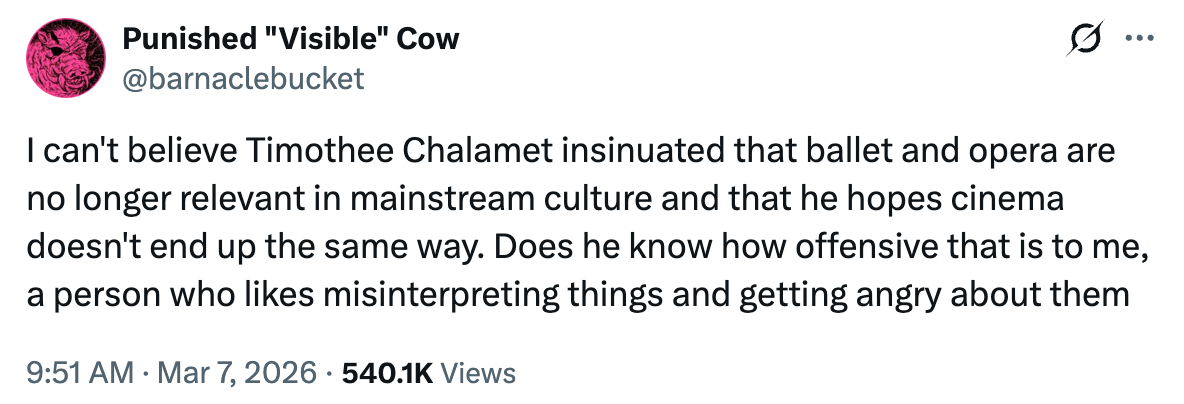
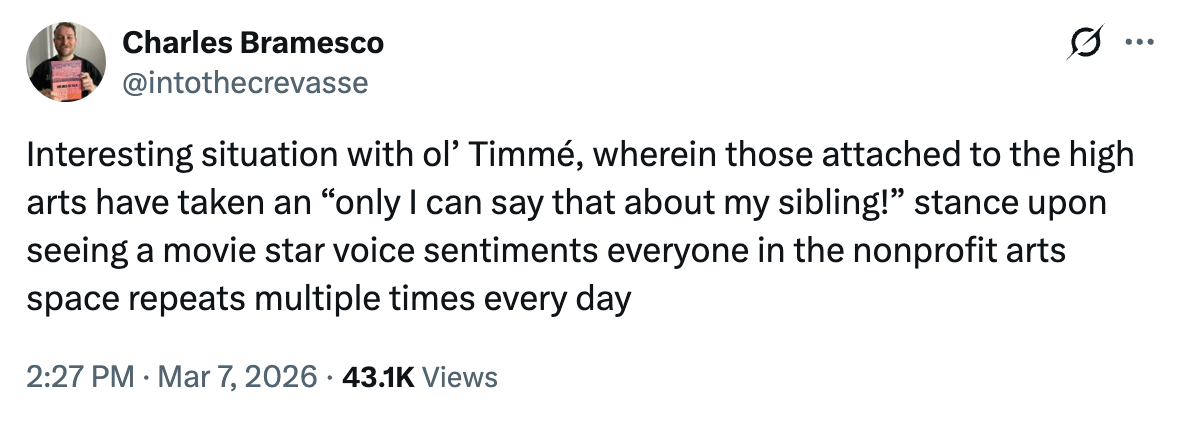
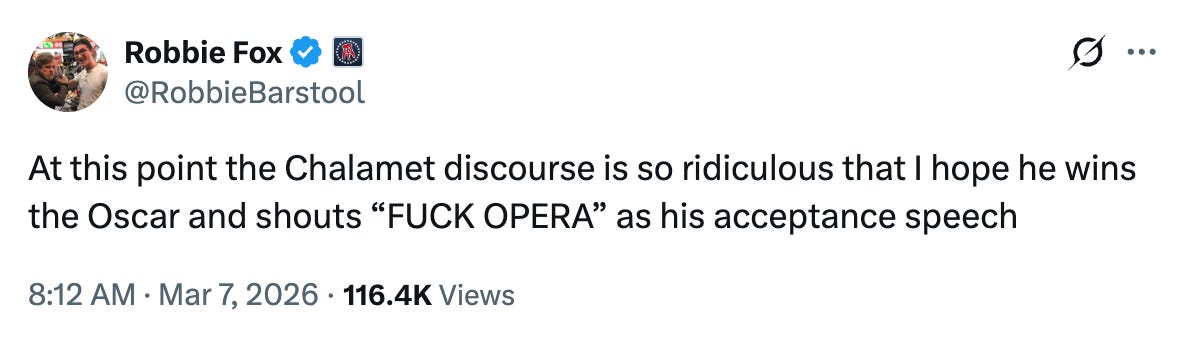
Don’t let the door hit you
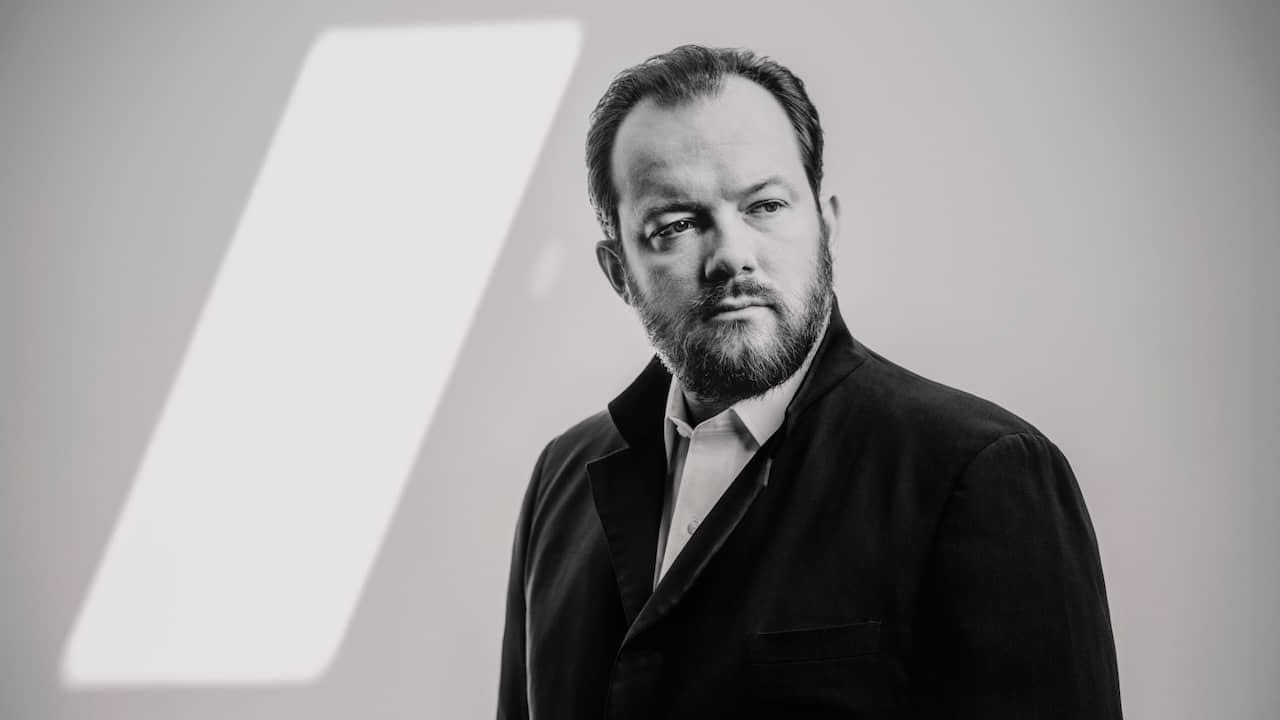
From the Boston Musical Intelligencer:
According to the Trustees of the Boston Symphony Orchestra and President and Chief Executive Officer Chad Smith, Andris Nelsons will conclude his BSO tenure after the 2027 Tanglewood season.
“The decision to not renew his contract was made by the BSO’s Board of Trustees because, beyond our shared desire to ensure our orchestra continues to perform at the highest levels, the BSO and Andris Nelsons were not aligned on future vision.”
That’s a very public — and slightly humiliating — way to go about canning your music director. It’s the kind of move you make if you think the offended party is going to get litigious or mount a big backlash campaign in public, all of which seems the opposite of Nelsons, who seems like a docile woodland gnome most of the time.
The only public(ish) statement he’s made is a letter to the musicians of the orchestra:
The Board has decided that my music directorship will conclude in August 2027, with the aim of a mutually amicable final chapter. While this is not the decision I anticipated or wanted, I am unwaveringly committed to you and to our work together.
I understand the decision was not related to artistic standards, performances, or achievements during my tenure, and, therefore, my focus is straightforward: to protect the music, support the orchestra’s stability, and continue to perform with the musicians of the BSO at the highest artistic level.
I have aimed to fulfill my responsibilities as Music Director with commitment, integrity and care. These responsibilities have always been of utmost importance to me, and I remain committed to achieving a successful 2026-2027 season.
The music we have made together, your artistry, trust, commitment, respect and generosity, have been extraordinary and irreplaceable gifts to me. Our musical journey has been one of the great privileges and joys of my life. I thank you with all my heart. Please know how deeply grateful to you. I am and always will be. You are the heart, soul and purpose of this institution.
Classy stuff.
The BSO musicians came out with this statement on social media:
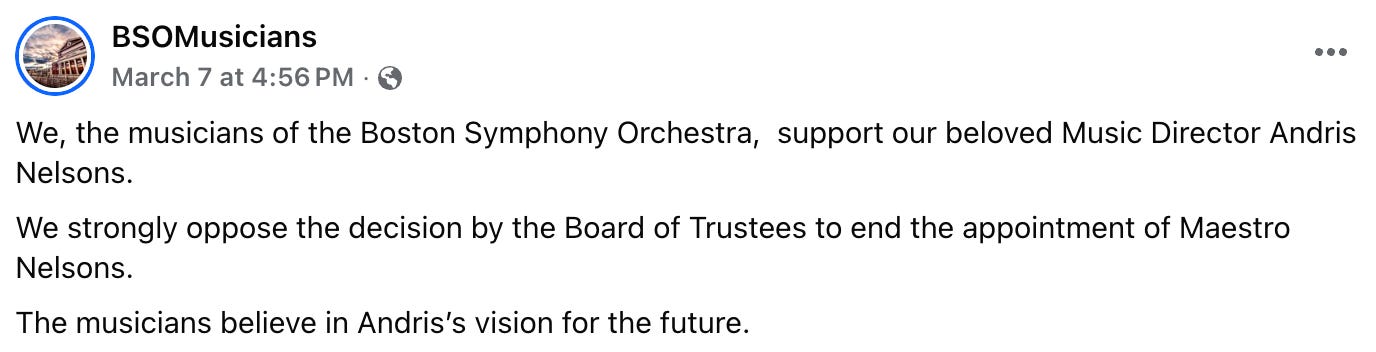
I mean, maybe they do and maybe they don’t. I would caution anyone reading a statement that supposedly represents the thoughts and feelings of a hundred musicians to consider what it takes to get unanimity from a string quartet.
I’m sure that many of them liked Nelsons, and the musicians who he hired probably feel a special loyalty to him. But I’m sure that many probably thought it was time for a change. From what I understand, he’s an “easy” conductor, who is happy to go with the flow during rehearsals and let people out early. That will always win you friends among some people. It’s possible that some musicians may not be all-in on Nelsons, but they still oppose this move because they weren’t consulted.
Ever since this story broke, there has been a war playing out in the pages of the major newspapers in Boston, New York, and London. Tom Service, for example, comes to Nelsons’ defense in The Guardian, the title of which refers to Nelsons as “one of the world’s great conductors.”
But the opening salvo in this war of words came in the form of a trenchant critique from David Allen in the New York Times:
Nelsons, 47, has become one of the most unfortunate symbols of all that is irresponsible about the overstretched, overtired, overindulged modern music director. It has been not only deeply frustrating, but genuinely sad, to witness his trajectory.
Every year since 2017 that Bachtrack, a leading listing website, has ranked the busiest conductors in the world, Nelsons has finished either first or second. Is it any surprise, then, that he has not fulfilled his potential?
Certainly, Nelsons has not achieved what he could in Boston. The shine of the early seasons soon dimmed. He still has his admirers, and he remains capable of real quality. But he has also proven himself able to conduct as if he has barely seen the score at hand. The Shostakovich survey did not end nearly as impressively as it began; remakes of Strauss tone poems that he had previously recorded in Birmingham testify to just what a sluggish and patchy interpreter he has become. Fundamentally, it has become hard to trust him in much music anymore.
There have been wider consequences. It took five years for Nelsons to approve the hiring of a concertmaster, delaying a needed revitalization in the strings. Some of the Boston players look oddly disengaged, and it is difficult to discern a collective identity in the playing like that so palpable with, say, the Cleveland Orchestra, the Pittsburgh Symphony or the Minnesota Orchestra. For the ensemble that once defined symphonic mastery in the United States and beyond, this is troubling.
The Boston Symphony’s board has done the right thing in parting ways with Nelsons but has a challenging period ahead. Its stalwart vice president of artistic planning, Anthony Fogg, will soon retire. The Tanglewood Festival Chorus needs a new director. Keith Lockhart, alas, cannot conduct the Boston Pops forever.
Outwardly, the organization would appear to be drowning in capital — in its 2024 fiscal year, it drew more from its endowment ($26.8 million) than the entire budget of the London Symphony Orchestra — but it needs more to renovate its aging facilities. It runs persistent, eye-watering deficits. All that, and the inconsistent standard of guest conductors over the past several years means that Nelsons has no readily apparent successor.
Smith, the orchestra’s chief executive, already had work to do to realize his expansive, progressive vision for the Boston Symphony’s future. Now he has more.
I find myself agreeing with this point of view, based on my limited knowledge of the situation. I have only seen Andris Nelsons conduct once, at a pair of BBC Proms concerts in August 2023. I reviewed those programs (along with a few others) in Tone Prose 52, so I’ll quote myself here:
The Boston Symphony is one of the world’s great orchestras; Andris Nelsons is not one of the world’s great conductors.
Everything about his performance as a conductor in these concerts was lackluster. He seemed only to half-know his scores (the telltale sign being that he held on for dear life to each page as he turned it), his beat was brittle, and he generally seemed less than fully engaged in everything he did. His tempi in the fast movements of the Prokofiev symphony were all a click or two too fast, such that he couldn’t even keep up with the tempo he had set. He was always a step behind the musical impulse of the scores. There was a fair amount of rough and tumble in the orchestra’s ensemble, in spite of the individual talents of the musicians, which are substantial.
Here’s a great example of where a friendly video editor could have made it seem like he was competent. With enough well-timed cutaways, it would be possible to give the impression that Nelsons was at least minimally competent in what he was doing. But I was there; I saw everything. I was someone in a tree.
I will give credit where credit is due and say that overall, the trajectory from Death and Transfiguration to La Valse was a positive one. Nelsons’ beat was particularly ill-suited to the rich textures of Richard Strauss, and it seemed like the Ravel had been rehearsed within an inch of his life, and performed recently enough that Nelsons remembered how it was supposed to go.
Tone Praise
Germaine Tailleferre, Harp Concertino
Tone Prose is a co-production of William White, Joseph Vaz, and the Listeners (i.e. you.)
NTT: I apparently need to brush up on my string chamber music repertoire. I'm thinking mid-to-late-eighteenth century for time, France for place. Franck most immediately jumped to mind at the beginning, but less strongly the longer the excerpt went. For others in my basket I'll put Saint-Saëns and Dukas.
NTT: this was a known quantity for me (and from what I've seen in the emails, for many of you as well!)